

If you’re a small business owner planning to build a website in 2026, you’ve probably noticed that website prices can vary dramatically.
You might find a website builder offering a site for a relatively small monthly fee, a freelancer quoting hundreds or thousands of dollars, and an agency proposing a much larger project.
So, how much does a small business website actually cost in 2026?
The honest answer is: it depends on how you build it, what features you need, and how much work you want someone else to do.
A basic website created with a website builder can cost a few hundred dollars per year or less, while a professionally designed custom website can cost several thousand dollars or more. Current 2026 pricing guides show that small-business website costs vary widely depending on design, functionality, content, SEO, integrations, and ongoing support.
The important question isn’t simply “What is the cheapest website?”
It’s:
“What is the most sensible way to get a professional website that supports my business without paying for things I don’t need?”
This guide breaks down the real costs, what you get at different price points, hidden expenses to watch for, and how AI website builders can significantly reduce the cost and time involved in getting online.
Quick Answer: How Much Does a Small Business Website Cost in 2026?
For a typical small business, you can broadly expect:
Website ApproachTypical CostBest ForDIY website builderLow monthly/annual subscriptionBusiness owners who want to build it themselvesAI website builderLow monthly/annual subscriptionBeginners who want AI to create the starting websiteFreelancerHundreds to several thousand dollarsBusinesses wanting someone else to build the siteWeb design agencySeveral thousand dollars and upBusinesses needing strategy, custom design and developmentCustom website developmentSeveral thousand to tens of thousands+Complex websites and specialized functionality
These are planning ranges rather than universal prices. A website with five simple pages is fundamentally different from an e-commerce store, booking platform, membership website, or custom web application.
For example, current Singapore market guides put basic business websites in the low-thousands of SGD, while more customized SME and e-commerce projects can reach much higher.
In other markets, the numbers will differ, but the underlying cost factors are similar.
What Determines the Cost of a Business Website?
Two businesses can ask for “a website” and receive completely different quotes.
That’s because website cost is influenced by several factors.
1. Number of pages
A simple website with five pages costs less to create than a website with 30 or 50 pages.
A typical small business might need:
Home
About
Services
Service detail pages
Blog
Contact
You don’t necessarily need dozens of pages when you’re starting.
2. Design requirements
A template-based website is generally less expensive than a completely custom design.
If you want:
Custom animations
Unique layouts
Bespoke graphics
Advanced interactions
Custom illustrations
Complex user experiences
the project will usually require more time and expertise.
3. Functionality
A basic informational website is relatively straightforward.
Additional functionality can increase costs significantly.
Examples include:
Online booking
E-commerce
Membership systems
Customer dashboards
Payment processing
CRM integrations
Appointment scheduling
Advanced forms
Custom calculators
Third-party APIs
Automated workflows
4. Content
Someone has to create the words and images on your website.
You may provide everything yourself, or you may pay a professional to create:
Website copy
Product descriptions
Service descriptions
Blog content
Photography
Graphics
Videos
Content can become a substantial part of the overall website budget.
5. SEO
Basic SEO setup can be included in modern website builders, but comprehensive SEO is a separate discipline.
A business may eventually invest in:
Keyword research
Content strategy
Local SEO
Technical SEO
Link building
Blog content
SEO reporting
It’s important to distinguish between having an SEO-friendly website and paying for ongoing SEO services.
Website Builder vs Freelancer vs Agency
One of the biggest decisions you’ll make is who—or what—builds the website.
There are three common approaches.
Option 1: Build It Yourself With a Website Builder
This is usually the most affordable approach.
You choose a website builder, select a template or generate a website, customize it, add your content, and publish it.
Modern website builders can include:
Hosting
Templates
Visual editing
Mobile-responsive layouts
SEO settings
Forms
Domain connection
Content tools
Some AI-powered builders can also generate the initial website from a description of your business.
This means you don’t have to start with a blank page.
Best for:
Small businesses
Freelancers
Consultants
Local service businesses
Startups
Solo entrepreneurs
New businesses
Option 2: Hire a Freelancer
Hiring a freelancer can make sense if you don’t have the time or don’t want to build the website yourself.
The cost depends heavily on the freelancer’s experience and project scope.
A simple template-based website might be relatively affordable, while a custom-designed website with content, SEO, integrations and multiple revisions can cost considerably more.
The advantage is that someone else handles much of the work.
The disadvantage is that you may still need to pay separately for hosting, maintenance, content, plugins, updates or future changes depending on the arrangement.
Option 3: Hire a Web Design Agency
An agency can provide a much more comprehensive service.
You might receive:
Brand strategy
UX research
Custom design
Copywriting
Development
SEO
Analytics
Integrations
Testing
Launch support
Ongoing maintenance
This can be valuable for businesses with complex requirements.
But for a small local business that simply needs a professional website with service information, contact forms, SEO basics and a blog, a large custom agency project may be more than necessary.
Current 2026 market guides show that agency-built business websites can range from several thousand dollars into five figures depending on scope and customization.
How Much Does a DIY Website Builder Cost?
Website builders generally use a subscription model.
Depending on the platform, you may pay monthly or annually.
Some platforms offer free plans, but professional businesses often need a paid plan for features such as a custom domain, additional storage, removing platform branding, or business functionality.
Industry pricing comparisons in 2026 show many mainstream website builders operating in the relatively low monthly-cost range, although prices and included features vary significantly between platforms.
The biggest advantage isn’t simply the subscription price.
It’s the amount of work you can avoid paying someone else to do.
What Does an AI Website Builder Cost?
AI website builders take the traditional website builder model one step further.
Instead of manually selecting every section, you can describe your business and let AI generate a starting point.
For example:
“Create a professional website for a local accounting firm that helps small businesses with bookkeeping, tax preparation and business consulting.”
The AI can use that information to create a website structure and initial content.
You then customize the result.
For small businesses, this can reduce the time required to go from idea → website → published site.
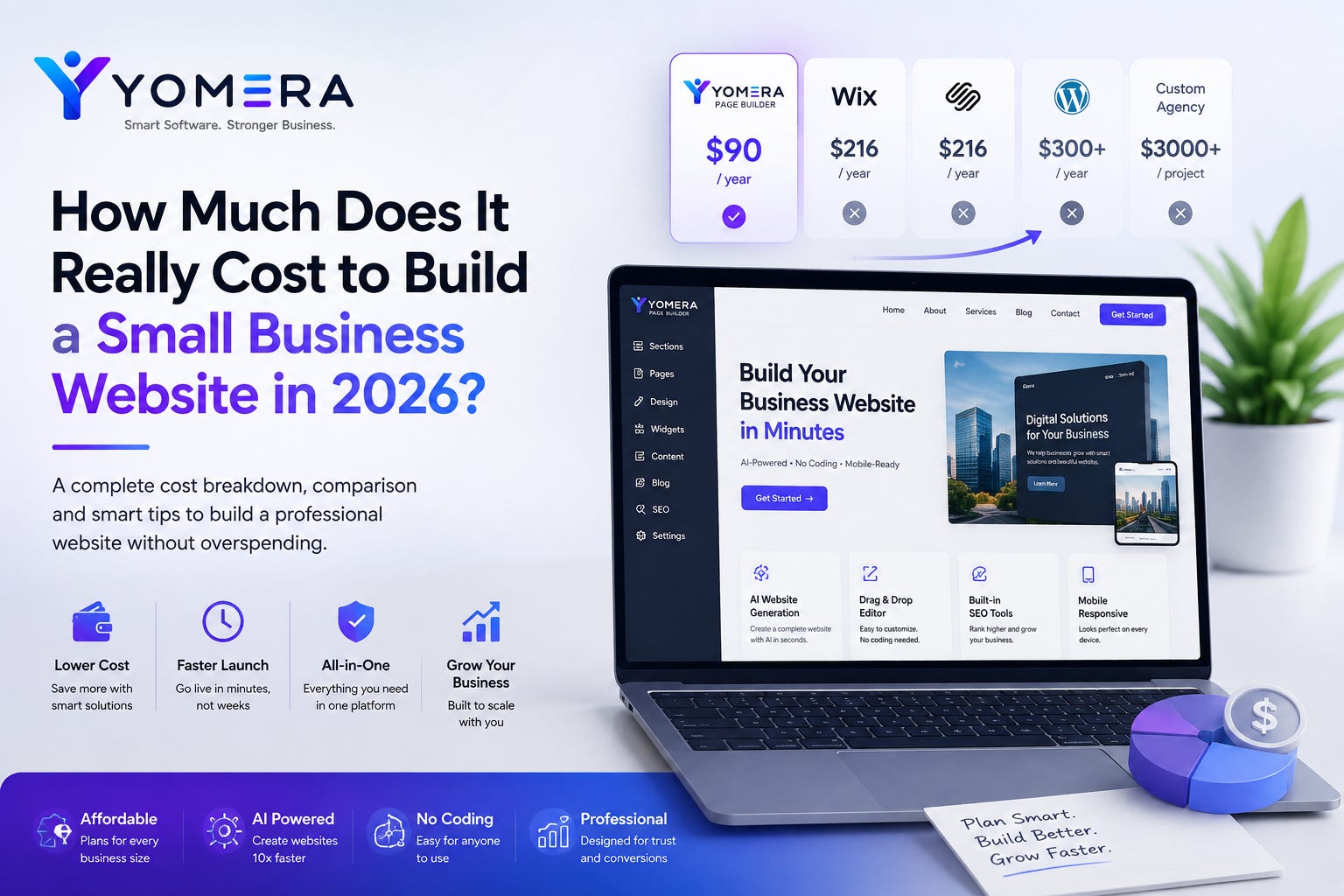
Yomera Page Builder: A Lower-Cost Way to Build a Business Website
If your goal is to create a professional business website without hiring a designer or learning complicated web development, Yomera Page Builder takes an AI-first approach.
You can start with your business description and generate a website rather than designing every section from scratch.
Yomera Page Builder also combines several features that businesses typically need when launching a website, including:
AI website generation
Drag-and-drop editing
Mobile-responsive design
Built-in SEO tools
AI-assisted blog writing
Website templates
Custom domain connection
Hosting
The current plans shown by Yomera Page Builder are:
$18/month — Monthly
$48/quarter — Quarterly
$90/year — Annual
That means a business can use the annual plan for $90 per year, according to the current pricing displayed by the platform.
For a small business that doesn’t need a complex custom website, this can be dramatically less expensive than commissioning a custom design project.
What Are the Hidden Costs of Building a Website?
The advertised website price isn’t always the final cost.
Before choosing a platform or accepting a quote, ask what’s included.
Domain Name
Your domain is your website address, such as:
yourbusiness.com
A domain is normally an ongoing annual expense unless it is included with your website plan.
The price depends on the domain extension and registrar.
Premium domains can cost considerably more.
Hosting
Your website needs somewhere to live.
Traditional websites may require separate hosting.
Many website builders include hosting in their subscription, which makes budgeting easier.
Always check whether hosting is included before comparing prices.
Website Maintenance
Websites aren’t always “build once and forget forever.”
You may need to update:
Business information
Services
Prices
Images
Blog posts
Forms
Software
Security
Integrations
A managed website builder can simplify some of this work.
Plugins and Add-ons
Some platforms have an ecosystem of plugins or extensions.
A website may initially appear inexpensive but become more expensive after adding premium:
SEO plugins
Form tools
Backup tools
Security tools
Analytics tools
Booking systems
Marketing tools
This is one reason you should compare the total cost of ownership, not just the starting price.
How Much Should a Small Business Actually Spend?
There is no universal number.
A useful way to think about your website budget is to work backward from what your business actually needs.
A simple informational website
If you mainly need:
Home page
About page
Services
Contact page
Mobile responsiveness
Basic SEO
Custom domain
you probably don’t need an expensive custom development project.
A website builder may be sufficient.
A lead-generation website
If your website’s purpose is to generate enquiries, you may need:
Strong landing pages
Contact forms
Calls-to-action
Testimonials
Service pages
Local SEO
Analytics
Blog/content strategy
The quality of the structure and messaging becomes more important than simply having a large number of pages.
An e-commerce website
If you’re selling products online, you’ll need additional functionality such as:
Product catalog
Shopping cart
Payments
Shipping
Taxes
Order management
Customer accounts
This requires a different budget and platform evaluation.
A custom web application
If you’re building something like:
A SaaS product
Customer portal
Marketplace
Booking platform
Complex database application
you’re no longer talking about a standard small-business website.
Custom development may be appropriate.
Cheap Website vs Affordable Website: They’re Not the Same
It’s tempting to choose the cheapest possible option.
But the cheapest website isn’t always the most affordable website.
Imagine you spend $100 on a website that:
Looks outdated
Isn’t mobile-friendly
Has poor messaging
Doesn’t generate enquiries
Is difficult to update
Has no useful SEO foundation
You may save money initially but lose potential customers.
An affordable website should provide value, not simply a low price.
A good small-business website should make it easy for customers to:
Understand what you do
Trust your business
Find the information they need
Contact you
Take the next step
Can AI Really Reduce Website Costs?
Yes—but it’s important to understand what AI does and doesn’t replace.
AI can significantly reduce the time required for tasks such as:
Generating initial page structures
Creating draft website copy
Suggesting layouts
Creating blog drafts
Organizing content
Producing variations of headlines
Assisting with SEO content
That can reduce the amount of manual work required.
However, AI-generated content should still be reviewed.
Your business expertise, customer knowledge and real-world experience are what make the final website valuable.
This is especially important for long-term SEO.
Google explicitly recommends creating helpful, reliable, people-first content rather than content produced primarily to manipulate search rankings. It also emphasizes original value, first-hand expertise and satisfying the user’s goal.
So the best approach isn’t:
“Let AI create everything and publish it.”
It’s:
“Use AI to accelerate the work, then add real business expertise and review the result.”
What Should You Look for in a Website Builder?
Don’t choose a website builder based only on price.
Look for the features that matter to your business.
1. Easy editing
You should be able to make changes without calling a developer every time.
2. Mobile responsiveness
Your website should work properly across smartphones, tablets and desktops.
3. Custom domain support
You should be able to connect your own professional domain.
4. SEO tools
Look for control over important SEO elements such as page titles, descriptions, headings and content.
5. Content tools
Built-in blogging or AI writing assistance can make publishing content easier.
6. Templates
Templates can dramatically reduce the time required to create a professional layout.
7. Hosting
An all-in-one platform can make website management simpler if hosting is included.
8. Scalability
Your website should be able to grow with your business.
9. Clear pricing
Avoid platforms where you cannot easily understand what you’ll pay after the introductory period.
10. Support
When something goes wrong, you should know where to get help.
How to Reduce Your Website Cost Without Sacrificing Quality
You don’t necessarily need to spend thousands of dollars to launch a professional website.
Here are several ways to control your budget.
Start with the essential pages
Don’t build 30 pages when five or six will do.
Start small and expand based on customer needs.
Use a professional template
You don’t need to pay for completely custom design if an existing template can deliver the structure you need.
Use AI for the first draft
AI can help you create initial website copy, page structures and blog content faster.
Build it yourself
If your website builder is easy to use, you may not need to hire a developer for routine changes.
Add advanced features later
Start with your core website.
Add booking, e-commerce, automation or integrations when your business actually needs them.
Choose an all-in-one platform
Combining website creation, hosting, editing, SEO and content tools can make the overall cost easier to manage.
Is a Website Builder Better Than Hiring a Web Designer?
It depends on your needs.
A website builder is often a better choice when you want:
Lower upfront costs
Faster launch
Easy editing
Templates
AI assistance
Built-in hosting
Simple SEO tools
Less technical management
A web designer or agency may be better when you need:
Highly customized design
Complex functionality
Advanced integrations
Custom user experiences
Extensive strategy
A large-scale website
For many small businesses, however, a modern website builder provides enough functionality to create a professional online presence without the cost and complexity of a custom development project.
How Much Does a Website Cost Over 3 Years?
This is a better question than simply asking about the initial price.
Imagine two options.
Option A: Custom website
You pay several thousand dollars upfront, then continue paying for hosting, maintenance, updates and other services.
Option B: Website builder
You pay a predictable subscription and manage many changes yourself.
The second option can be substantially less expensive for a simple business website.
That’s why businesses should compare three-year total cost of ownership, not just the initial quote.
Ask:
How much will this website cost me over the next 12, 24 and 36 months?
That number gives you a much clearer picture.
Frequently Asked Questions
How much does a small business website cost in 2026?
There is no single price. A DIY or AI website builder can cost a relatively small monthly or annual subscription, while freelancer, agency and custom development projects can cost hundreds, thousands, or tens of thousands depending on scope. Current 2026 pricing guides show substantial variation based on functionality, design, content and development requirements.
Is it cheaper to build a website yourself?
Usually, yes, if your requirements are straightforward and you are comfortable using a website builder. You save much of the labor cost associated with hiring a designer or developer.
Can I build a professional website without coding?
Yes. Modern website builders are designed specifically to let people create websites without writing code. AI-powered builders can make the initial process even faster.
Do I need to pay separately for hosting?
Not always. Many website builders include hosting in their plans. Always check what’s included before comparing prices.
Do I need to hire an SEO expert?
Not necessarily when launching a basic business website. A good starting point is to create useful content, optimize your pages, make your website technically accessible to search engines, and target relevant search terms. More competitive businesses may eventually benefit from professional SEO.
Is an expensive website automatically better?
No.
A $10,000 website isn’t automatically better than a $500 website.
The right question is whether the website solves the business problem it was designed to solve.
How quickly can I build a business website?
A simple website can potentially be created in a day using a modern website builder. AI-powered tools can make the initial creation process even faster. The amount of time required still depends on how much content, customization and review are involved.
Final Verdict: What Should a Small Business Spend on a Website in 2026?
For most small businesses, the smartest approach is not necessarily to spend as much as possible.
It’s to spend enough to create a trustworthy, fast, mobile-friendly and useful website—and avoid paying for complexity you don’t need.
If you need a highly customized platform, an agency or development team may be worth the investment.
But if you need a professional website for a local business, service business, consultant, freelancer, agency or startup, a modern AI website builder can dramatically reduce the cost and complexity of getting online.
With Yomera Page Builder, businesses can start with AI-generated website creation, customize the result with visual editing, use built-in SEO and blogging tools, connect a custom domain, and manage their website from one platform.
Instead of spending thousands before your business even gets online, you can start with a simpler approach and invest more as your business grows.
The best website budget isn’t the biggest one. It’s the one that gives your business the right website for its current needs—and room to grow.
Ready to Build Your Business Website?
If you’re looking for a faster and more affordable way to create a professional business website, try Yomera Page Builder.
Start with your business idea, generate your website, customize it, connect your domain and publish.
Build. Customize. Publish.
Your next website doesn’t have to cost thousands of dollars—or take weeks to launch.